Running the workshop
Personas, journeys and touch points
How to run the room: the Lego Serious Play warm-up, persona walkthroughs, journey mapping, and how to record emotional touch points.
Before the room
The workshop fails or succeeds in the fortnight before it. Three decisions matter most.
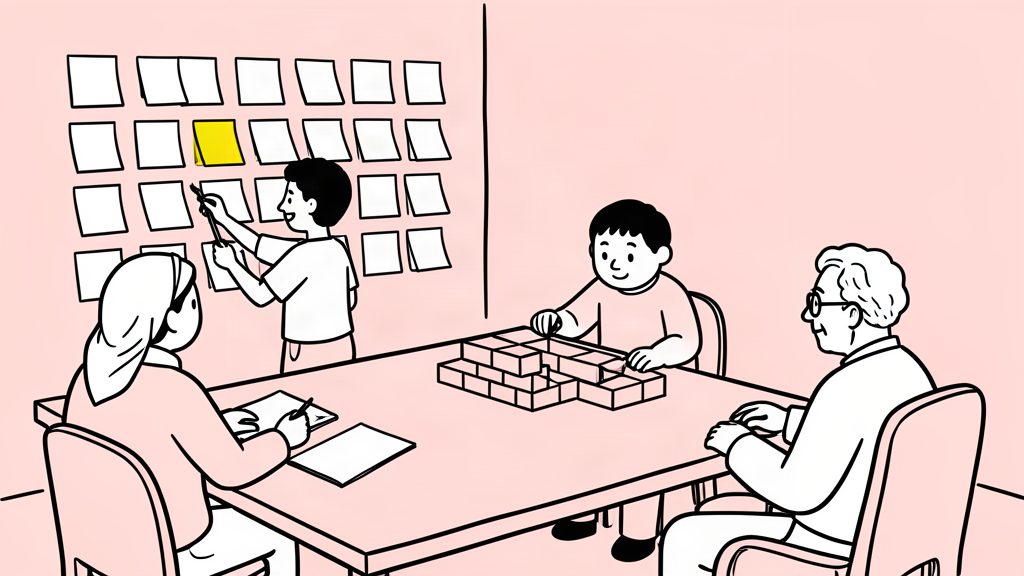
The individual techniques are catalogued on their own page: co-production techniques, with how to run each one, what it produces and how strong the evidence is.
Who is in the room. Invite people with lived experience of the service, people who deliver it, people who refer into it, and unpaid carers. It is rarely possible to include everyone, so decide whose perspective is critical and record who you left out.
Blank board or seed map. The guidance calls this the choice between a blank sheet and a preliminary map. Start blank if time allows. Use a seed map if the topic is complex, and say whose assumptions are already on the page.
How the material will be captured. Two scribes beat one. Decide in advance whether you are recording, and take written consent. Say what will be quoted, and whether a quote can be withdrawn later.
The kit
- Building material for the warm-up, and a camera.
- One large sheet per persona, at least A1, on a wall or a long table.
- Sticky notes in three colours, and a pen for every person.
- A printed pathway document, to compare designed with lived.
- Printed persona cards, each with the functional label and sourced attributes.
- Touch point cards with the recording fields already printed.
The shape of the day
A full day, ten to four, with a long lunch. The timings assume twelve to eighteen participants.
| Time | What happens | What the scribes are writing down |
|---|---|---|
| 10.00 | Welcome, purpose, boundary, and what happens to the material | The boundary as stated |
| 10.15 | Build-based warm-up in small groups | Photographs, and the group's words |
| 11.00 | Break | Nothing |
| 11.15 | Persona walkthrough, one persona at a time, whole room | Steps in the group's words, who does what, what the persona must do |
| 12.30 | Lunch | Nothing |
| 13.30 | Journey mapping in small groups, then play-back | Contradictions between groups, quoted both ways |
| 14.30 | Touch point pass: where does each persona feel something, and what | Touch point cards, one per point, with a quote |
| 15.15 | Missing personas: who does this journey imply but not name | The names put forward, and by whom |
| 15.45 | Close: what happens next, and when they will hear from you | The commitment and the date |
Warming the room with a build
The first task is to make something, not to talk about the system. Building first gives everyone a task with no correct answer, so seniority stops doing the talking. The room's own words also arrive before yours do.
How to run it
- Set the task, not the answer. Ask each small group to build the journey that someone has to make to get help, from the person's point of view. Five minutes, no words on bricks, no writing allowed.
- Circulate and ask, do not correct. Ask what each part represents and who does the work at that point.
- Debrief at the wall. Each group gives a thirty second tour. The facilitator notes the words they use for the steps.
- Harvest the language, not the models. The builds are not the map; they are the dictionary. Take the group's words into the persona walkthrough.
Lego Serious Play is a trademarked method with its own training and material rules. The pattern here is the general one: build first, talk second, use the group's words. Any construction kit will do.
Walking a persona through the pathway
A persona is a functional position, not a character. Use a label such as "parent of a child referred by a health visitor". Do not invent a name, an age or a diagnosis. Every attribute should come from the material, or be labelled as the team's inference.
Walk one persona at a time with the whole room, on one large sheet. Take the steps in the group's own words. At each step, ask four questions:
- Who does what here? Name the person and the organisation, not the team.
- How long does it take? Waiting time is part of the journey, and services usually omit it.
- What must the persona do to make this step happen? Chasing, repeating, translating, paying, arranging, travelling. This work is what the journey map exists to reveal.
- What are they told? The instruction as received, not the instruction as written.
Keep three things apart on the sheet: the designed pathway, the lived pathway, and the work the persona does to bridge the two. Where the group disagrees, write both versions down. A contradiction preserved is a finding. One smoothed over is a lost one.
Recording a touch point so it is usable later
A touch point is any point on the journey where the persona feels something. Emotion is information about the system, so record it like any other datum rather than summarising it at the end of the day. Give each touch point its own card, and fill every field at the time. The card is the unit of analysis later, so a missing field is a hole in the analysis.
| Field | What goes in it | Why |
|---|---|---|
| Persona and step | The functional label and the step name | Traces the point to a journey |
| What happened | One sentence, in the group's words | Keeps the point concrete |
| What was felt | The word the group used, plus any severity | Emotion is a determinant, not decoration |
| Quote | Verbatim, with who said it and their role | Coding without a quote is opinion |
| Level | Person, team, organisation or policy | Stops a system condition being coded as psychology |
| Source | Who said it, where, and on what date | Makes the traceability check possible |
| Uncertainty | High, medium or low, and what would resolve it | Lets the analysis weight the material honestly |
Making the room work for everyone
The guidance asks for content and process that are accessible to all stakeholders, language included. Plan this before the day rather than improvising on it.
- Language. Book interpreters in advance, including for British Sign Language, and brief them on the method. Translate the persona cards and the touch point fields, not just the invitation.
- Literacy. Do not run an activity that requires writing to take part. Take spoken contributions through a scribe, and use images, objects and sorting tasks for the mapping itself.
- Disability. Ask about access needs in the invitation and act on them: step-free routes, a quiet room, a hearing loop, readable materials, and a break pattern that does not punish people who need to move.
- Digital access. If anyone joins remotely, send materials in advance and nominate someone in the room to speak for the screen. The guidance notes that interaction is easier in person, and online sessions usually need to be shorter and more frequent.
- Power. Split into small groups for the first pass so the loudest voice is not the only voice. Pay people for their time and cover travel and care costs.
- Distress. Some touch points are painful to describe. Say at the start that anyone can step out, and never require someone to justify their experience to the room.
After the room
Consolidate within forty eight hours, while the recordings still make sense. Transcribe, label the builds, date the photographs, and file the touch point cards as a set. Then do two things that are easy to skip.
- Read the material back for gaps. Which persona appears only in someone else's words? Those positions are step five, and they are a gap in the room rather than a persona.
- Go back to the participants. The guidance asks for regular feedback between mapping activities. Send the consolidated journeys and ask what is wrong.