The method at a glance
Nine steps from personas to impact
The whole route on one page: workshops, journey maps, touch points, coding, causal loops, leverage, techniques and the logic model.
What the method is for
Method choice comes first, and it is a design decision rather than a workshop decision. The Design Framework in the UK guidance asks 13 questions across three considerations: the scope of the project, the added value of a participatory approach, and the capacity to deliver the method you pick. Work through them before you book a room. The answers decide whether you need a causal loop diagram, a systems-based theory of change, a fuzzy cognitive map, a systems dynamics model, a CECAN PSM map or a Bayesian belief network.
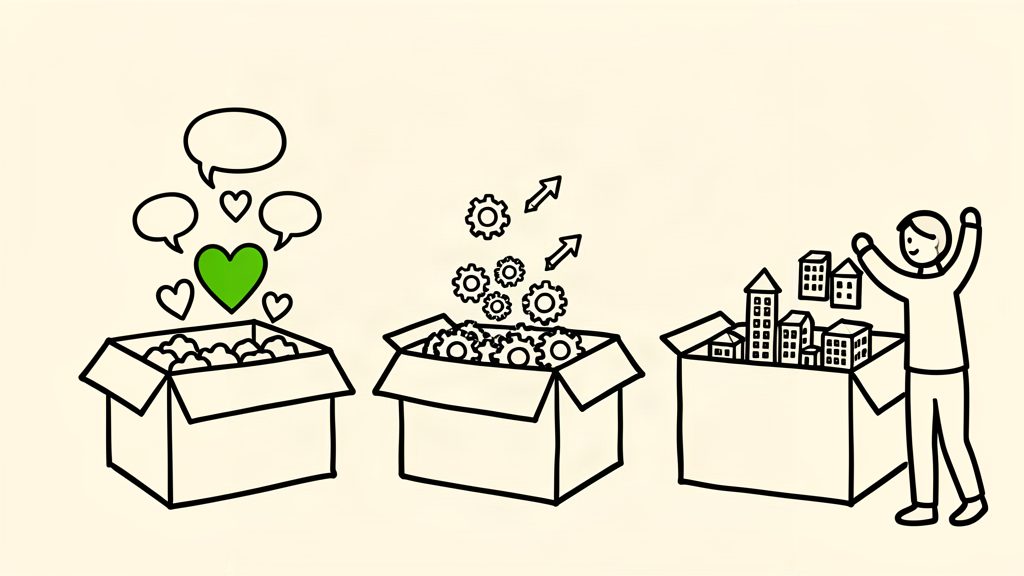
Once the method is chosen, the route is broadly the same. A room of people who know the system builds a picture of it. The picture is coded against established frameworks. The coded picture becomes a causal loop diagram. The diagram shows where a change would spread furthest. Techniques and strategies are chosen to act at those points. The whole argument is then written down as a logic model.
Nine steps, and each one leaves an artefact behind. This page sets out what each step produces and who owns it. The workshop page covers the room. The coding page covers the analysis.
The nine steps and what each produces
The output column is the one that matters. If a step leaves no artefact, you cannot defend the step that follows it.
| Step | What happens | Output you keep | Owner |
|---|---|---|---|
| 1. Choose the method and design the project | Work through the Design Framework. Define the boundary and say what participation adds. | A completed framework, a chosen method, and a written boundary statement. | Principal investigator and method lead |
| 2. Warm the room with a build-based task | The group makes something together before it describes anything. | Shared objects, agreed words for the system, and photographs of both. | Facilitator |
| 3. Walk personas through the pathway | Each persona is walked from first contact to exit, step by step. | One journey per persona: the steps, who does what, and what the persona must do to keep it moving. | The room, consolidated by the team |
| 4. Record the emotional touch points | The group marks every point where a persona feels something, and says what. | A touch point log with the location, what was felt, and a verbatim quote. | Scribes, checked by the room |
| 5. Add the personas nobody named | The journeys are read back for people the service and the room have left out. | A short list of missing positions, each with the material it rests on. | Analysis team |
| 6. Code the material | Touch points and the demands behind them are coded: the TDF for what has to change, the same framework extended to name the mechanism, and CFIR for the organisational level. | A coded needs analysis: TDF domains, the mechanisms each one operates through, and CFIR constructs for the organisational level. | Two coders, working independently, then reconciling |
| 7. Convert the map into a causal loop diagram | Factors become variables, and relations become links with a polarity. | A variable list, a link list with evidence for each link, and loops labelled reinforcing or balancing. | Analysis team, with the map in front of them |
| 8. Find the leverage points | Connectivity and loop membership are counted, not asserted. | A ranked list of nodes, and up to five candidate intervention points with risks. | Analysis team |
| 9. Select techniques and assemble the logic model | Coded determinants are matched to techniques and strategies, then ordered into a model. | A technique and strategy table, then inputs, activities, outcomes and impact with an evidence label on every row. | Principal investigator and intervention designers |
Who does the work
Five roles carry the method. In a funded project they are usually five different people. In a doctoral project they may be one person and a supervisor, which is a feasibility issue the Design Framework asks you to notice in advance.
Method lead
Owns the Design Framework answers, the boundary, and the choice of method. Guards the boundary when the room wants to widen it.
Facilitator
Runs the room and manages the power dynamics in it. The guidance is direct on this point: skilled facilitation is an investment, not a luxury.
Scribe
Records steps, quotes and touch points as they happen, with enough detail that someone who was not in the room can code them later.
Two coders
Code the same material independently and then reconcile. The disagreements are reported rather than averaged away.
The room
Holds the knowledge the map is made of. The map is a record of what these people think causes what, at this point in time.
Where the steps depend on each other
The method is a chain, and every link has a gate. Each gate is a question you can answer with yes or no.
- Before the workshop. Is there a written boundary and a stated purpose? A map without a boundary cannot be finished, only abandoned.
- Before coding. Does every touch point have a location, a person and a quote? Coding needs a source to point at.
- Before the causal loop diagram. Has the journey material been through step five? A diagram built from incomplete journeys will quietly reproduce the gaps.
- Before the leverage analysis. Is every variable a quantity that can rise or fall? People and activities are not variables.
- Before strategy selection. Has every determinant been given an actor and a behaviour? A framework label on its own is not a finding.
- Before anything is used. Can every claim be traced to a quote or a framework term? The traceability check is the one to keep if you keep only one.
What the method does not produce
Four limits are worth stating on the first page of any protocol.
- It does not describe the service. It describes how the people in the room understand the service. The two are not the same, and the gap is data, not error.
- It does not estimate effect. Nothing in the route produces an effect size, a cost or a probability of success.
- It is not designed to be reproducible. The guidance is explicit that a different group would draw a different map, and that this is not a fault. Diversity of the group is what protects you, not repeatability.
- It has no gold standard for leverage. There is no agreed method of identifying leverage points. Counting connectivity is one route. Network analysis and expert judgement are others. Say which you used.
Time and the shape of a project
In practice the method runs in three movements. Design and recruitment take the longest and produce nothing visible. The workshop is one day, sometimes two half days. Analysis runs for weeks, and it is where projects stall, because coding and diagram work compete with everything else.